

Bishop’s Address to Diocesan Synod – May 2026
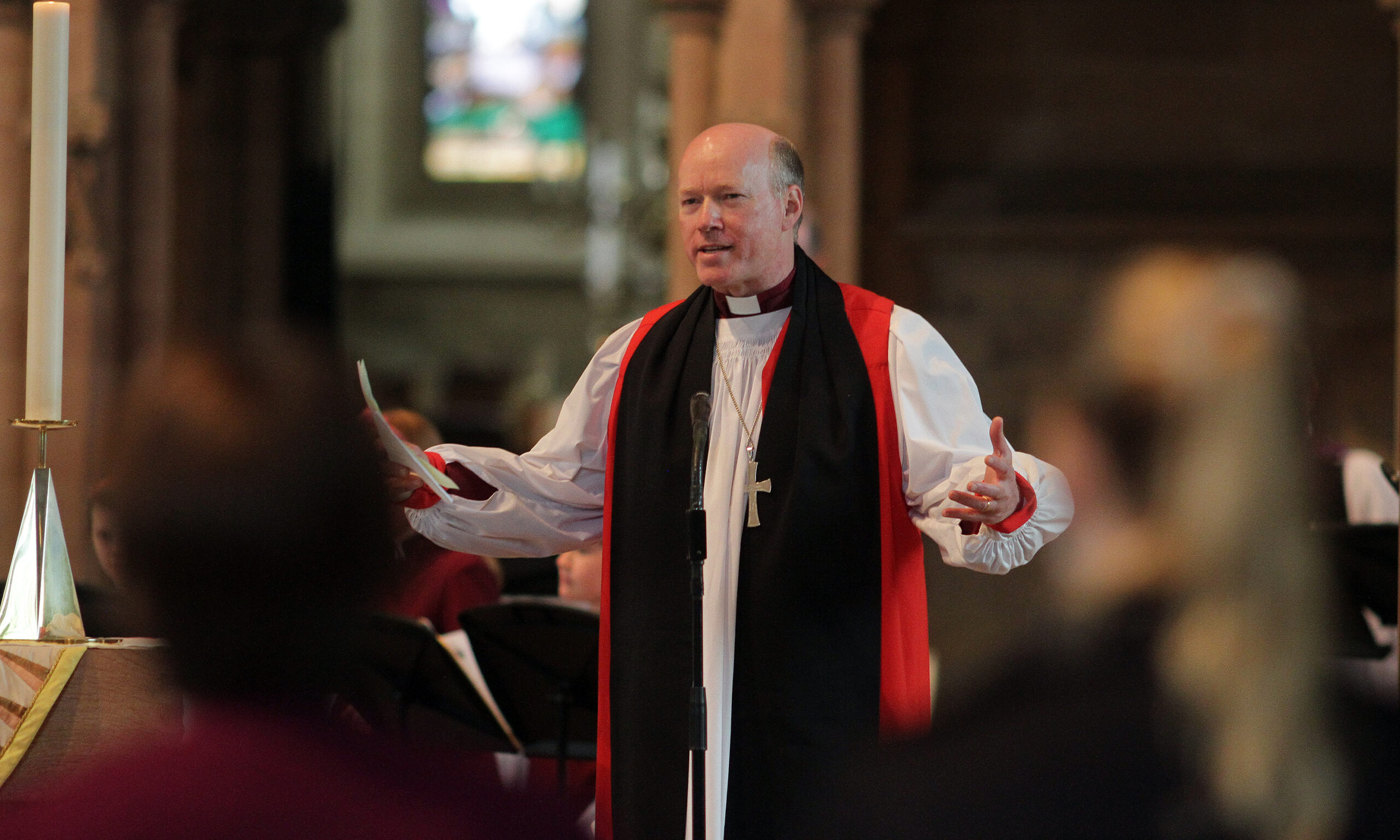
This is the transcript of Bishop Paul’s address to Diocesan Synod on 9th May 2026.
Good morning, Synod. Shortly after being appointed Bishop of the Diocese of Wakefield in 1992, Nigel McCulloch declared that the diocese was to be renamed, ‘The Missionary Diocese of Wakefield’.
At the time it had been struggling in various ways and morale was low. So it was a clear statement of intent that the whole life of the diocese, every action, every prayer, every appointment, the stewardship of finances, was to be shaped by a single focus, not to be deflected from being a missionary church: to be more confident speaking about Jesus and inviting people to become his followers.
Nigel also placed an infectious emphasis on seeking a fresh anointing of the Holy Spirit for every person across the churches. Perhaps that’s why in his first year he recruited from Southwell and Nottingham, our very own John Finney to be his suffragan bishop. Those of you who know the story of the fresh move of the Holy Spirit in this diocese in the 1970s and early 80’s will be aware of the role that John, among others, played in that season of spiritual renewal.
In his second year, with John Finney now by his side, Nigel announced he had set himself a target to personally pray for and anoint 2000 people across the churches that year. None of this surprised me, as I had experienced his ministry previously when he was Bishop of Taunton. On one occasion, I bumped into him in the town centre when I was briefly home during my second year at university, age 20.
I happened to mention that I had just been appointed the President of the Christian Union in Durham – I was feeling rather daunted at the prospect of leading what was then the largest society in the university with over 500 active members. Without hesitation he invited me to his home so that he could take time to pray for me. So, a few days later I was in his study as he spent time encouraging me and prayed for me. It struck me more recently that this was perhaps a first for Durham CU, to have been anointed by a bishop for the office of President.
In my first year in Southwell & Nottingham, there was no change of name for the diocese – that had happened ten years before when Nottingham was added to Southwell to more clearly identify with the city and wider county. Yet when I addressed this Synod in 2016 towards the end of my first year, I set out the single focus that had emerged from all the conversations and deliberations of the previous twelve months – that there would be only one priority as a diocese which was Growing Disciples.
Following Nigel McCulloch’s example, we set some bold aspirations of what we would work and pray for – focusing particularly on growing younger leaders, establishing new worshipping communities, developing larger resourcing churches growing to give themselves away, while contending together in prayer to bear witness to Christ in every place and sphere of life across the city and county. The boldness and clarity were affirmed by Synod, though with a sense of trepidation and excitement. It also garnered a few critiques beyond the Synod in the wider church, though that is not always a bad thing as there is always something you can learn from even your harshest critics.
By the autumn we had launched the younger leadership college which incorporated the intern programme, Trinity Church was founded (which means it is soon coming up to its 10th anniversary), we launched the Potting Shed Church, started meeting regularly with the leaders of 20 or so potential larger resourcing churches, and new worshipping communities were started and revitalisations underway, partly supported by funding from the national church.
Of course, all this was reviewed while coming out of COVID as we refreshed the diocesan vision and strategy for the next 7-10 years. The single priority remains Growing Disciples, with seven focus areas we identified as essential elements in a healthy and growing church, whatever the size, context or tradition. We will consider some of the progress and encouragements we have seen with this in our next item on today’s agenda.
My message to this Synod, in reminding us of these things, is two-fold: that we are marked by thankfulness and humility: truly thankful for all the Lord is doing and in humility we growing in our dependence on the Holy Spirit to anoint and empower us for the good work he has prepared and is calling us to in the days to come.
On a personal level, I am therefore praying we’ll have the curiosity and eagerness to continue learning how to be a missionary people in a missionary diocese: Growing Disciples in obedience to the Great Commission of Jesus, with increasingly Christ-like compassion, confidence and courage.
So let me very briefly share with you four things I have been reflecting on and am continuing to learn:
First of all, that an anxious world needs a joyful church, and a joyful church will be a thankful church. I want to continue learning the discipline of gratitude, that our eyes will be open to see all that God is doing, staying close to him, being guiding by his presence. For as the Psalmist says, ‘in his presence there is fulness of joy.’
The second thing I am learning is how prayer is the principal means by which faith is increased and power released – this is the fuel that will fan into flame the spiritual fire that is needed at this Kairos moment for the church. I want to keep learning how to pray with increasing dependence on the Lord and to pray for the Holy Spirit to awaken and renew his church. I am always thankful to be pray and anoint…
Thirdly, I am learning how a Spirit-filled church is a church of dreamers and visionaries – people who will not be overwhelmed by the circumstances of their lives or the wider society and world around.
Let us pray for more dreamers and visionaries in every church – not only among the young but also our very oldest members. And not just for the renewal of the church but also the transformation of society: there is a crisis of godly imagination in our culture and as the church we have been given a mandate to dream and re-create, and re-cultivate.
On the Day of Pentecost, Peter announced that the prophecy of Joel had been fulfilled:
“In the last days, God says, I will pour out my Spirit on all people. Your sons and daughters will prophesy, your young men will see visions, your old men will dream dreams. Even on my servants, both men and women, I will pour out my Spirit in those days, and they will prophesy. I will show wonders in the heavens above and on the earth below…”
Friends, we are living in those days. They are now.
Fourthly, the spiritual, relational and missional culture of the church is the soil in which fruitful lives and ministries are able to flourish (and let me be clear that this incorporates ‘safeguarding’ as a fully integrated part of all we do). In the kingdom of God, it is our spiritual culture that matters most (that is, living holy lives in obedience to Christ).
On their own it is not our strategies and plans that will enable healthy mission and ministry to be truly fruitful.
We need therefore to pay careful attention to nurturing a spiritual healthy culture – it will never be perfect with frail people in a broken world, but it can have integrity, with a purposeful commitment to grow grace and truth, so that we will be people who live and lead out of love and not fear, as we pursue the purposes of God in our generation.
In an undefended way, let’s continue learning together – that is what disciples do. It’s what is means.
Let me conclude by thanking you for your partnership on a personal level and together as a Synod. I pray that we may grow in thankfulness and humility as we continue in the mission of God, fully dependent on the Lord as his followers and in growing disciples everywhere – villages, towns and city – to his glory.